
.svg)
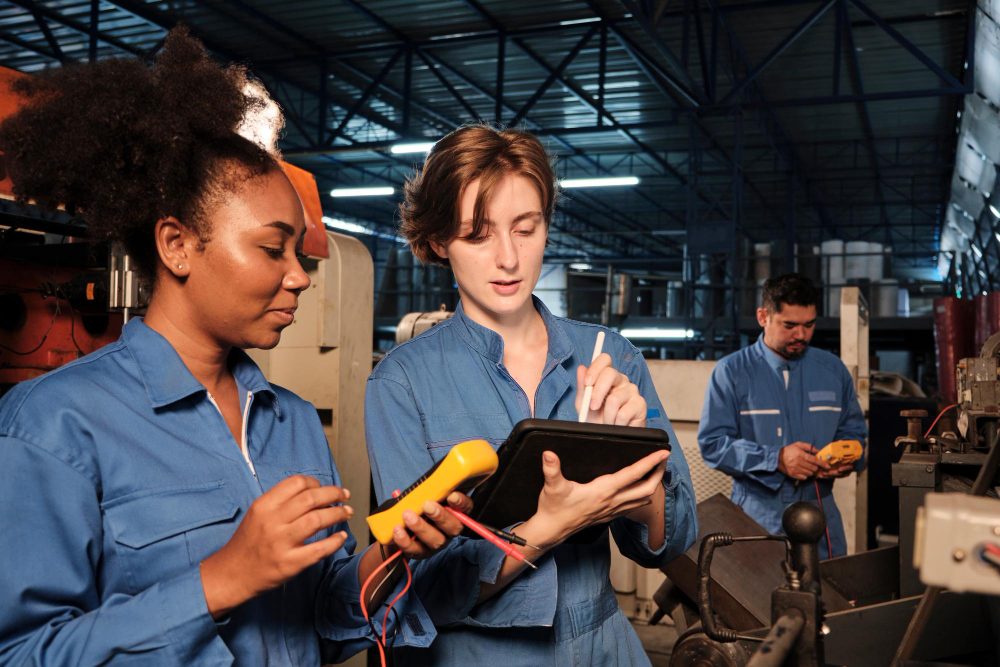
Manufacturing technicians are the backbone of production operations. They install equipment, run diagnostic tests, troubleshoot problems, and perform routine maintenance that prevents costly downtime. A technician might replace a worn bearing, recalibrate a sensor, review data on a control panel, or coordinate with a team to fix a production bottleneck, all within a single shift.
The work demands a blend of mechanical intuition and technical literacy. Technicians read electrical schematics, interpret performance data, and make decisions under time pressure. They follow strict safety protocols, including lockout-tagout procedures (isolating machinery before repairs) and wearing appropriate protective gear. Equipment accidents are preventable through discipline and attention.
Most roles involve rotating shifts and occasionally night or weekend work, especially during peak production periods. Maintenance windows often provide quieter times for training and reflection. Many technicians value the combination of hands-on problem-solving and physical work, it's concrete and measurable, not abstract or behind a desk.
The Manufacturing America Alliance connects candidates with employers across the sector to understand where manufacturing technician roles fit within the broader jobs landscape and regional opportunity.
Manufacturing encompasses numerous technician specializations. Production technicians run equipment and manage output targets. Maintenance technicians handle repairs and preventive upkeep to extend equipment life. Instrumentation and control technicians work with sensors, gauges, and automated systems that monitor and adjust production parameters in real time.
Other paths include quality-assurance technicians (inspecting products and analyzing test data), electrical technicians (managing motors, wiring, and power distribution), and hydraulic technicians (servicing fluid-power equipment). Mechatronics specialists, technicians who blend mechanical and electronic expertise, bridge mechanical and electronic systems, often managing robots and programmable logic controllers (PLCs, small computers that automate production sequences).
The roles often overlap. A production technician performs basic maintenance. A maintenance technician helps troubleshoot control logic. Certifications and additional training allow technicians to transition between roles and advance into supervisory or specialist positions.
Unmudl provides specialized training in control systems and instrumentation for technicians ready to deepen expertise. Explore Unmudl's mechatronics training to learn advanced systems. Courses like the Instrumentation and Control Technician: Fundamentals of Control Systems prepare you for job-ready work in weeks rather than semesters.
.jpg)
Salary varies by region, experience, and specialization. Entry-level technicians in many states earn between $30,000 and $37,000 annually. Experienced technicians with multiple certifications often reach $45,000 to $55,000, with supervisory and specialist positions earning considerably more. Overtime is common in high-demand sectors like automotive, semiconductors, and aerospace, which can push annual compensation significantly higher.
Geography matters substantially. Technicians in industrial hubs like the Midwest, Texas, and the Carolinas tend to earn more than those in rural areas. Employers competing hard for talent offer shift premiums for overnight work, production bonuses, and sometimes tuition assistance for further credentials.
Beyond base salary, benefits add real value. Most employers provide health insurance, retirement matching, paid time off, and access to training programs. Some offer relocation assistance or signing bonuses. That total package can add 20 to 30 percent to the apparent wage.
Salary growth accelerates with certifications and specialized expertise. A technician who earns credentials like CMRP (Certified Maintenance and Reliability Professional) and develops deep knowledge in a specific area can reach upper-range earnings within 5 to 10 years. Advanced data-analysis skills open doors to higher-paying roles in predictive maintenance and production optimization.
Employers screen intensely for specific competencies. You need to read electrical schematics and understand mechanical drawings. Basic math, fractions, geometry, simple algebra, appears constantly in daily work. Troubleshooting logic (testing hypotheses methodically rather than guessing) separates strong technicians from those who struggle.
Industry certifications carry significant weight. NCCER (National Center for Construction Education and Research) offers portable credentials in electrical work, mechanical systems, and instrumentation that employers recognize nationwide. OSHA 10 (a foundational occupational safety course) is nearly mandatory. NATE (North American Technician Excellence) certifies HVAC and refrigeration specialists. ASE (Automotive Service Excellence) matters heavily in automotive sectors. For reliability specialists, SMRP offers the CMRP credential, a genuine differentiator that correlates with higher pay and advancement.
Soft skills are equally important. You need to communicate clearly with team members, follow written instructions precisely, ask questions when something is unclear, and maintain a safety-first mindset even under deadline pressure. Consistency and reliability in attendance separate people who get hired from those who lose opportunities.
Technical literacy increasingly matters. You should feel comfortable learning new software tools, reviewing digital dashboards, and grasping what a programmable logic controller (PLC) actually does and why. If you lack familiarity with basic electricity or hydraulics, beginner courses build that foundation quickly.
The hiring process for technician roles follows a predictable path. First, identify openings. Most manufacturers post jobs on Indeed, LinkedIn, and specialized job boards. State manufacturing councils and the Manufacturing America Alliance often host hiring fairs and apprenticeship matching events that connect candidates directly with employers.
Second, prepare your application strategically. Highlight relevant experience, even from unrelated fields. Construction work, automotive service, facilities maintenance, or military service all demonstrate mechanical aptitude and discipline. List every certification you hold, no matter how small. Employers scan resumes specifically for OSHA, NCCER, ASE, and similar credentials. If you lack formal certifications, honestly note hands-on experience (rebuilding engines, assembling equipment, troubleshooting systems, etc.).
Third, expect a screening interview. Employers ask what attracted you to manufacturing, why you'd stay with the role, and how you handle pressure or mistakes. They probe your comfort with technical concepts and your genuine willingness to learn new tools. Be direct and authentic. Employers value honesty over polish.
Fourth, you'll likely face a technical assessment or skills test. You might troubleshoot a simple circuit, read a schematic, perform basic mechanical tasks, or solve logic puzzles. These tests assess practical ability and problem-solving approach, not just memorized knowledge.
Fifth, if you advance, you'll interview with the team that would supervise you. This conversation is usually casual and focuses on day-to-day fit, shift flexibility, and genuine interest in the work.
Getting hired becomes significantly easier if you have relevant certifications or completed structured training beforehand. Focused training pathways with Unmudl compress months of skill-building into intensive, employer-designed courses. Many participants finish training, earn a recognized credential, and move directly into jobs within weeks.
You don't need a traditional two-year community college program to enter this field, though that's a valid option if you're starting from zero technical foundation. Unmudl offers shorter, focused training designed by employers like Amazon and Intel to address real manufacturing gaps.
If instrumentation and control systems interest you, the Instrumentation and Control Technician: Fundamentals of Instrumentation course teaches sensor types, calibration, and real-world troubleshooting in weeks. The companion course on Fundamentals of Control Systems covers how PLCs and automated production sequences work. Both courses include the Instrumentation and Control Technician: Virtual Lab, which gives you hands-on practice in a simulated environment before stepping onto a live production floor.
If data analysis appeals to you, reviewing production metrics, identifying efficiency patterns, recommending improvements, the Data Analyst Technician pathway teaches fundamentals quickly.
These courses are stackable. You complete one, earn a certificate, and move toward employment. If you want to deepen skills later, take another course. Over time, you build a portfolio of recognized credentials without the time or cost of a traditional degree.
Many employers also offer tuition assistance or training stipends for employees seeking further development. Manufacturing America's partner network coordinates regional hiring initiatives where training and job placement work hand in hand, eliminating the common "training-to-employment gap" that frustrates career changers.
Join the Manufacturing America Alliance State manufacturing councils and employer groups nationwide are actively filling technician roles and building sustainable talent pipelines. Connect with Manufacturing America to learn about regional hiring initiatives, employer partnerships, and coordinated training in your area.
Manufacturing technician careers offer genuine opportunity in 2026. If you're willing to learn and develop hands-on skills, employers across the country are ready to hire. Start by exploring focused training options with Unmudl, connecting with state manufacturing councils, and reaching out to local manufacturers about openings. The path from training to your first technician job has never been clearer.

As manufacturers reshore with smart automation, technician roles shift from assembly to systems troubleshooting. Explore skills gaps, training timelines, and hiring strategy.


Navigate reshoring finance: CHIPS Act grants, IRA tax credits, WOTC subsidies, and state programs explained. Maximize your manufacturing expansion ROI.

Build career pathways that reduce reshored-facility turnover by 40%. Learn succession planning, training ROI, and 24-month advancement strategies today.


.svg)